

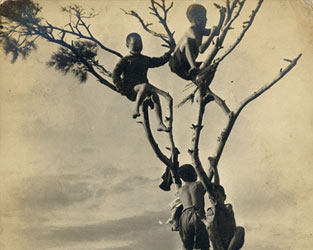
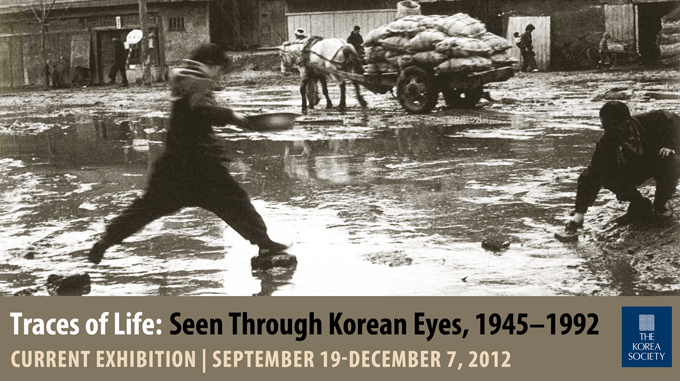
Experience the captivating imagery in this collection of photographs by some of the pioneers of modern Korean photography. The fifty-four photographs showcase the first generation of Korean realists who played a pivotal role in the development and enrichment of Korean photography as an art form. The exhibition marks the first time these original black and white photographs have been mounted in the United States and fills a chasm not only in the visual archive of modern Korean photography but also in the visual vernacular of the period.
Traces of Life: Seen Through Korean Eyes, 1945–1992 reveals everyday life through exuberant visual diversity and documents anthropologically important aspects of Korea’s nearly forgotten recent past. The photographs offer a counter-narrative of ordinary lives during this turbulent period of Korean history. These photographs are documentary, but at the same time aesthetically charged, illustrating and illuminating the traces and trails of Korean life as seen through Korean eyes.
The selected photographs are on loan from one of the first public photography museums in Korea, Dong-Gang Museum of Photography, and from several of the photographers and their estates. The thirteen photographers represented in the exhibition are Koo Wangsam, Lim Eungsik, Lee Haesun, Lee Hyungrok, Kim Hanyong, Han Youngsoo, Chung Bumtae, Choi Minsik, Joo Myungduk, Hong Suntae, Yuk Myungshim, Kim Kichan, and Kim Soonam.
This exhibition is the product of a joint effort between The Korea Society and an independent curator, Chang Jae Lee. Traces of Life will be on view in the Korea Society Gallery from September 19 through December 7, 2012. This exhibition, along with other exhibitions created by The Korea Society, is available for loan to universities and museums and other qualifying institutions in the United States. Please click below for booking information or contact Jinyoung Jin.
September 19-December 7, 2012
This program is supported, in part, by public funds from the New York City Department of Cultural Affairs in Partnership with the City Council.
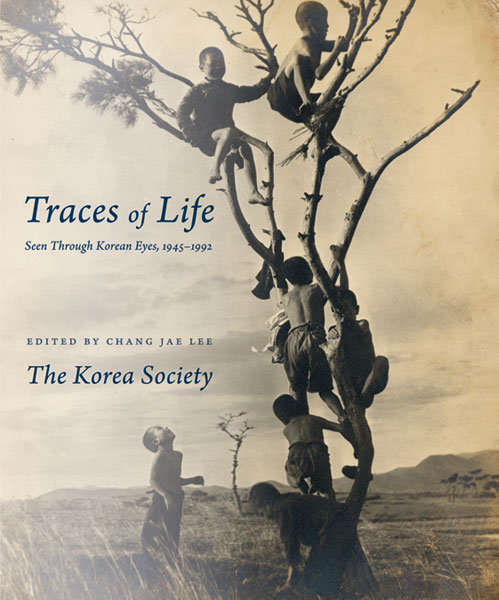 Catalog Available:
Edited by Chang Jae Lee
Published by Noonbit Publishing Co., September 2012
pp. 136 (in English 110 pp. including 54 plates, in Korean 26 pp.)
Foreword by Jinyoung Jin (TKS Gallery Director), introduction by David R. McCann (Korea Foundation Professor of Korean Literature at Harvard University), contributing essay by Sun Il (Curator of the Seoul National University Museum), and curatorial essay and afterword by Chang Jae Lee (Curator of Traces of Life).